Members Login
Username 
 
Password 
    Remember Me  
Post Info TOPIC: Learning the Prophet's Guidance Through Hadith and Seerah


Newbie

Status: Offline
Posts: 8
Date:
Learning the Prophet's Guidance Through Hadith and Seerah


fiqh-islamic-studies-online.webp

Learning the Prophet's Guidance Through Hadith and Seerah

A student may read a Hadith about something the Prophet Muhammad said or did, then later encounter the same period in a Seerah book. The two sources may seem to be doing the same job. They are not.

Hadith studies examine individual transmitted reports and the scholarship surrounding them. Seerah follows the Prophet's life as a historical narrative. There is overlap between the two, but each asks different questions and gives the student a different kind of context.

Hadith focuses on individual reports

Hadith is more than a collection of sayings. Traditional Hadith scholarship considers how a report was transmitted, who narrated it, how scholars assessed its chain and text, and how it relates to other reports.

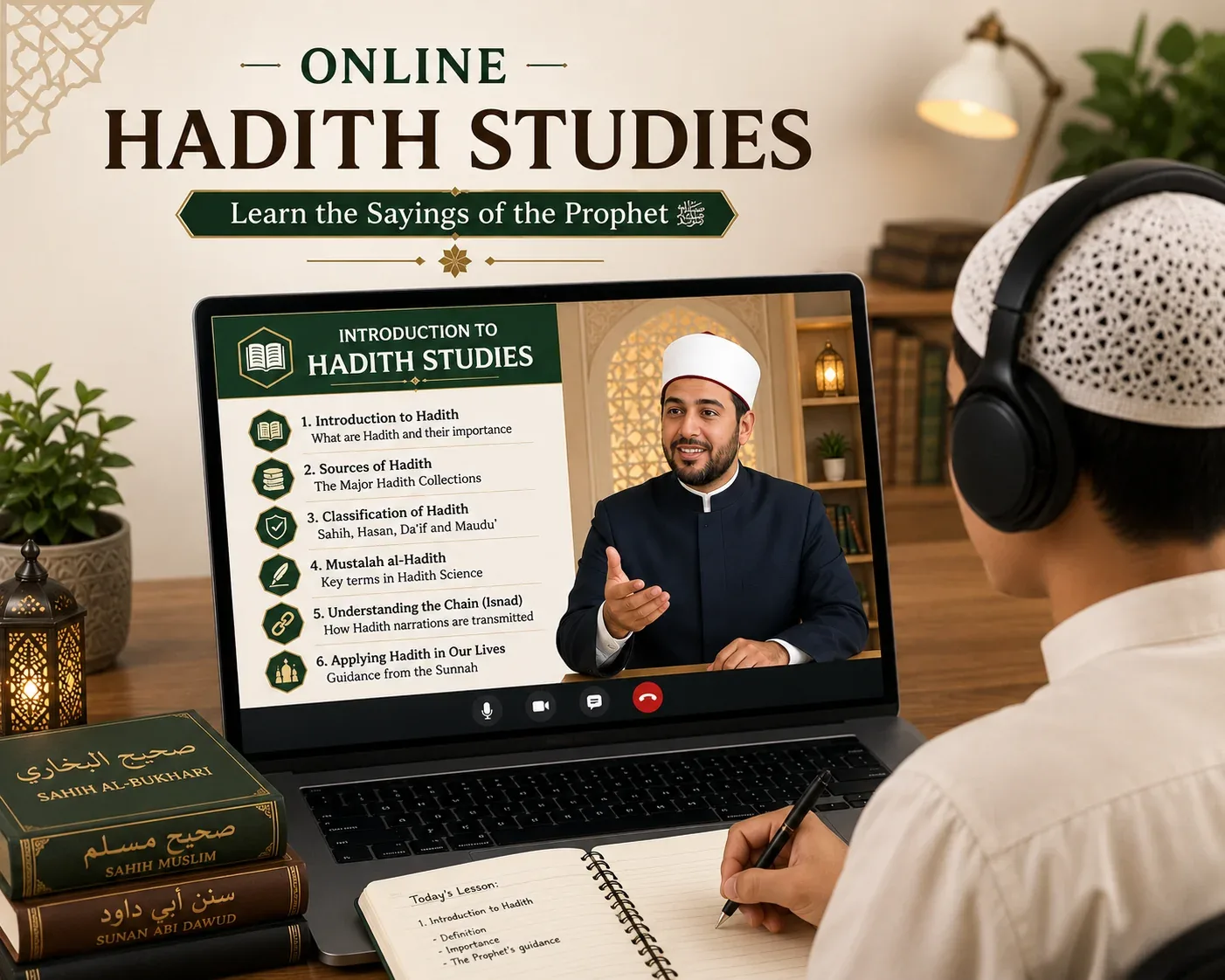
A beginner taking an online Hadith course may start with selected narrations, basic terminology, and explanation. More advanced Hadith studies can move into classification, chains of transmission, narrator criticism, and differences between collections.

That background matters when reading a narration. A report may need to be considered alongside other evidence, and questions about authenticity or context cannot always be answered from the wording alone.

This is one reason Hadith study should not be reduced to memorizing quotations. The subject also involves learning how reports were preserved, examined, and understood within Islamic scholarship.

Seerah follows the life of the Prophet

Seerah works on a wider scale.

A study of the Prophet Muhammad biography follows the main stages of his life and mission. It may cover his early life in Makkah, the beginning of revelation, opposition to the early Muslims, the migration to Madinah, the development of the Muslim community, major expeditions and treaties, and the final years of his life.

A Seerah course online usually gives students a chronological framework. That framework becomes useful when a Hadith refers to a particular journey, dispute, treaty, person, or stage of the Prophet's mission. The historical setting can change how clearly the report is understood.

Seerah should not, however, be treated as simply Hadith arranged in date order. Historical works can draw on different kinds of transmitted material, and not every report used in a historical narrative carries the same level of authentication.

The distinction is easy to miss because both subjects deal with the same person and often the same events. Their methods are still different.

Where the two subjects meet

Suppose a student is reading about an event from the Madinan period. A Seerah work may explain what was happening in the Muslim community, which people were involved, and where the event fits in the broader sequence of the Prophet's life.

Hadith sources may preserve particular statements, actions, or details connected with that period.

Reading only the Hadith can leave the historical setting unclear. Reading only the Seerah can produce a smooth narrative without drawing enough attention to how individual reports were transmitted or assessed.

This is where the two subjects complement one another. Hadith narrows the focus. Seerah widens it.

They should still remain distinct. One is not a substitute for the other.

A practical order for beginners

Someone new to the subjects does not need to begin with advanced Hadith criticism. An overview of Seerah can first provide the chronology and major events. Selected Hadith can then be studied with explanation and attention to their sources.

That order is not a rule, but it gives beginners a useful reference point when later material becomes more detailed.

Al Quran Recitation Academy is one resource readers may consider when comparing options for Islamic studies online. Its Hadith and Seerah subjects are presented separately, which reflects an important distinction students should understand before treating the two fields as interchangeable.

Knowing the difference changes the way both are read. Seerah explains where events fit. Hadith study asks more closely what a particular report says and how it reached us.


__________________
Page 1 of 1  sorted by
Quick Reply

Please log in to post quick replies.

Tweet this page Post to Digg Post to Del.icio.us


Create your own FREE Forum
Report Abuse
Powered by ActiveBoard